
PAST RESEARCH PROJECTS AND PARTNERSHIPS
PAST RESEARCH PROJECTS AND PARTNERSHIPS
ARCHIVES
PROJECTS // 2011–2012 2012–2015 2014–2015 // PARTNERSHIPS
2011 / 2012
Management trials
Over the course of five years, Cribit Seeds tested different crop management practices. Management practices we have tested include:
Seed Applied Treatments
Foliar Applied Fungicides
Seeds Rates
In 2011/2012, Cribit Seeds received funding from the Growing Forward Program and the Agricultural Adaptation Council to launch a two-year seed and foliar treatment trial.
The 2011/2012 project entailed evaluating the performance and interaction of different seed treatments and foliar fungicides that had recently been registered for use with oats and barley.
The performance measures were yield and disease control, including true loose smut in barley (see current research) and Fusarium head blight as measured by DON testing.
Click here for more information about the 2011-12 Seed Treatment and Foliar Trial Final Report.
-
Fungicide Seed Treatment
Yield: After multiple years (2011-present) of testing fungicide seed treatments, regardless of which fungicide seed treatment was used, the impact was approximately a 5% increase in oat and barley grain yield.
Exception: In 2015, there was no observed increase in oat grain yield. In 2016, seed treatment had a negative effect on oat yield. (2016 was a very dry year.)
Disease: DON (Vomitoxin) testing during 2011/12 indicated low fusarium in those years. DON testing in 2013 indicated elevated fusarium pressure. The average DON measurement across the plots in 2013 was approximately 2ppm in barley at Winterbourne, 1.5ppm in barley at Conn, 1.5ppm in oats at Winterbourne, and approaching non-detection in oats at Conn.
In 2013, at both locations, comparing plots treated with a fungicide seed treatment vs. untreated, there was observed a slightly lower DON level in the barley plots treated with a fungicide seed treatment and no difference in DON level on oat plots treated with a fungicide seed treatment.
Insecticide Seed Treatment
After three years studying insecticide seed treatments, regardless of which neonictinoid insecticide seed treatment was used, we determined no significant yield increase above fungicide seed treatment used alone on oats and barley (2011-14).
A slight yield increase for spring wheat was observed in 2013; the only year we included spring wheat.
This evidence re-affirmed our practice of using only a fungicide seed treatment on oats and barley processed in our facility.
Biological Seed Treatment or Biological Foliar Application
We continue to participate with private partners to test beneficial fungi as a seed treatment or foliar application. We do not have enough data at this point to comment on the viability or practicality of these treatments.
Nutrient Additive Seed Treatment
We observed a slight, but not consistent yield increase, with the addition of nutritional seed treatment (2013-2015) and therefore have not adopted the practice.
-
In 2011/12, with one application of any foliar fungicide treatment, compared to a no-spray control, we noted a grain yield increase in barley of 2-16% and oats of 4-11% across the plots.
This affirmed our recommendation for growers to use at least one fungicide application in crop for oats and barley.
-
Oats
After two years of testing AAC Bullet oats at three different seeding rates, we saw no consistent yield advantage, but observed increased lodging risk, when seeding rates exceeded 1.1 million seeds/acre, which is approx. 130lbs/acre.Barley
After testing three Ontario barley varieties for two years at three different seeding rates a similar conclusion was drawn. There is no advantage to increasing seeding rates above 1.2 million seeds/acre, which is approx. 130lbs/acre.Malted Barley
Western malting barleys appear to respond to higher seeding rates.
2012 / 2015
CEREAL FORAGE trials
From 2012-2015, Cribit Seeds planted small replicated plots of single cereal, multiple cereal mixtures or mixtures with peas. Up to 25 forage mixes were evaluated per year.
The performance measures were yield and Relative Feed Value (RFV). Varieties of oats and barley bred in Western Canada, material bred for forage purposes and provided by SeCan, were also included. Of the Western material, CDC Haymaker showed promise and above average yield (2013,2015).
Summary of Results
There is no meaningful difference in yield or RFV whether a dark ‘forage’ pea or CDC Meadow yellow field peas is used in a mixture.
Using fungicide seed treatment, nutrient additive or biological seed treatment does not meaningfully affect yield or RFV.
This has reaffirmed our practice of not using a seed treatment on seed of a crop to be harvested as forage.
Straight oats will yield 5% more but have slightly lower RFV when compared to the average of all items and mixtures that were tested.
Of the straight oat varieties, CDC Haymaker is the best when combining yield and RFV, but it loses that advantage when mixed with peas.
MaxMilk or pea/oat 50:50, offers average yield but 5% better RFV.
UNCERTAINTIES
Triple Crown or pea/oat/barley 40:30:30 is over 5% above average in yield and slightly below average in RFV.
Oat/Barley/Wheat 33:33:33 is slightly above average in yield and over 5% below average in RFV
Pea/wheat/barley 20:20:60 is about 5% higher in yield but almost 10% lower in RFV
Straight barley is lower yielding and lower RFV than straight oats.
Note: We supported the University of Guelph 2014/15 project that examined forages harvested at 4 different stages of cutting, by suggesting forage mixture combinations, and providing seed for the project. Many results were similar; however, the U of G study raised a concern when feeding a cereal forage to dry dairy cows leading up to calving.
2014 / 2015
Nitrogen Response Trials
In 2014 and 2015, Cribit Seeds provided research sites to OMAFRA to re-establish nitrogen response curves for oats and barley. This information had not been updated since the 1970’s.
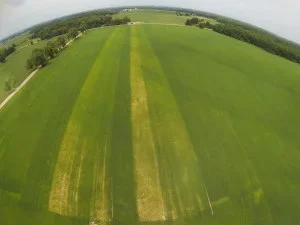
Nitrogen Response in Oats ‘14
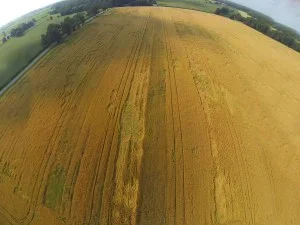
Nitrogen Response in Oats ‘14
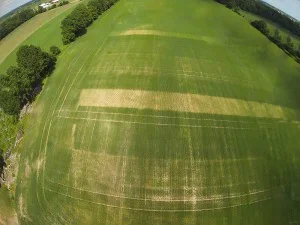
Nitrogen Response in Barley ‘14

PAST PARTNERSHIPS
Monsanto Development strip trials for soybeans
Soybeans planted into high amounts of corn residue

UNIVERSITY OF GUELPH Gryphon’s LAAIR project
Under the direction of Dr. Bill Deen, Associate Professor, Plant Agriculture, University of Guelph
Host location for aerial (drone-mounted) thermal imaging of crops to evaluate soil type differences, deficiencies of nutrients or disease within field crops

Cribit Seeds and Endo Plant Health Inc. biological foliar spray
Split field trial, to evaluate control of white mold in soybeans

Cribit Seeds and SeCan soybean variety strip trials
Evaluation of new soybean varieties